Guides · By Sub-Zero Repair Cherry Hills ·
Sub-Zero Ice Maker Troubleshooting: Symptoms, Checks and Fixes
To troubleshoot a Sub-Zero ice maker, confirm it is switched on, open the water supply, clear any flashing ice cube fault, then check the filter and condenser before booking a repair. This guide takes each symptom in order for Cherry Hills Village homes.
A Sub-Zero ice maker that stops working nearly always fails for one of four reasons, and you can test them in this order: it has been switched off or paused, the water supply is shut or restricted, a clogged filter or dusty condenser is slowing production, or a part such as the fill valve has worn out. The first three are owner checks that take minutes and need no tools beyond a flashlight and a towel. Work through them from the control panel back to the wall valve, and only call for service once those come up clean. Each section below names the symptom, the safe check and the point where it stops being a homeowner job.
First, make sure the ice maker is really on
Look at the touch control before anything else. On Classic and Designer models, and on the IW-30CI, one ice cube icon tells you the ice maker is running, while three cubes mean Max Ice is active. No cube at all means the ice maker has been turned off, often by a stray tap while wiping the panel.
Sabbath Mode is the next suspect. It shuts down the ice maker system and the door alarm and keeps both off, and if the power blinks the unit comes back up still in Sabbath Mode. A household that used it over a holiday can easily forget it is set. The 500 Series and the UC-15I have no Sabbath Mode, so on those this cause is ruled out.
Then check the bin. Classic (CL) and Designer (DET, DEC) ice makers wait 3 minutes after the bin comes out before they resume, and Sub-Zero recommends switching the ice maker off if the bin will stay out for a long time. A bin that sits a quarter inch proud of its stop can keep the ice maker idle indefinitely, so push it firmly home.
On a UC-15I, the DELAY key pauses production for 2, 4 or 8 hours depending on whether you press it once, twice or three times. Auto Delay repeats that pause every 24 hours and has to be set again after an outage, so a schedule someone programmed months ago may explain an empty bin every afternoon.
No ice at all: follow the water
If the icon is lit but the bin stays empty, trace the water. On many Classic Series units, a single ice cube icon flashing with no alarm means the water valve stayed open too long, and the controls disabled the ice maker so it could not flood the cabinet. Confirm the shut-off valve under the sink or in the basement is fully open, pull the unit out only if it slides easily, and check that the copper or braided line behind it is not kinked. Once water is flowing, press and hold Alarm until CFC (Clear Fault Codes) appears.
Pressure and room temperature matter too. Sub-Zero’s guidance for a UC-15I that hums along with an empty bin is to confirm the incoming line delivers at least 20 psi (1.4 bar) and no more than 80 psi (5.5 bar), and that the room stays from 50°F to 100°F for the indoor model or 50°F to 110°F for the outdoor version. A machine installed in a garage, pool house or unheated basement bar can drop below that lower limit during a Colorado cold snap and simply stop.
Slow production or small, hollow cubes
When ice arrives but in thin, undersized batches, the filter is the most common culprit. On CL, DET and DEC touch controls, Snooze/Refresh appears when the water filter or air purification cartridge is due. Snooze buys 24 hours, and a fresh cartridge resets the countdown for about a year. To swap a Classic filter, lift the grille from its lower edge, give the old cartridge a quarter turn counterclockwise and pull it free, take the plastic cap off the new one, push it in and turn it clockwise, then follow the prompts on the panel.
The UC-15I tracks its filter differently: REPLACE FILTER lights in red after 8000 ice-making cycles, and holding CLEAN for 6 seconds clears the warning once the new filter is in. Whatever the model, expect the first ice after a change to be cloudy or small while air works out of the line.
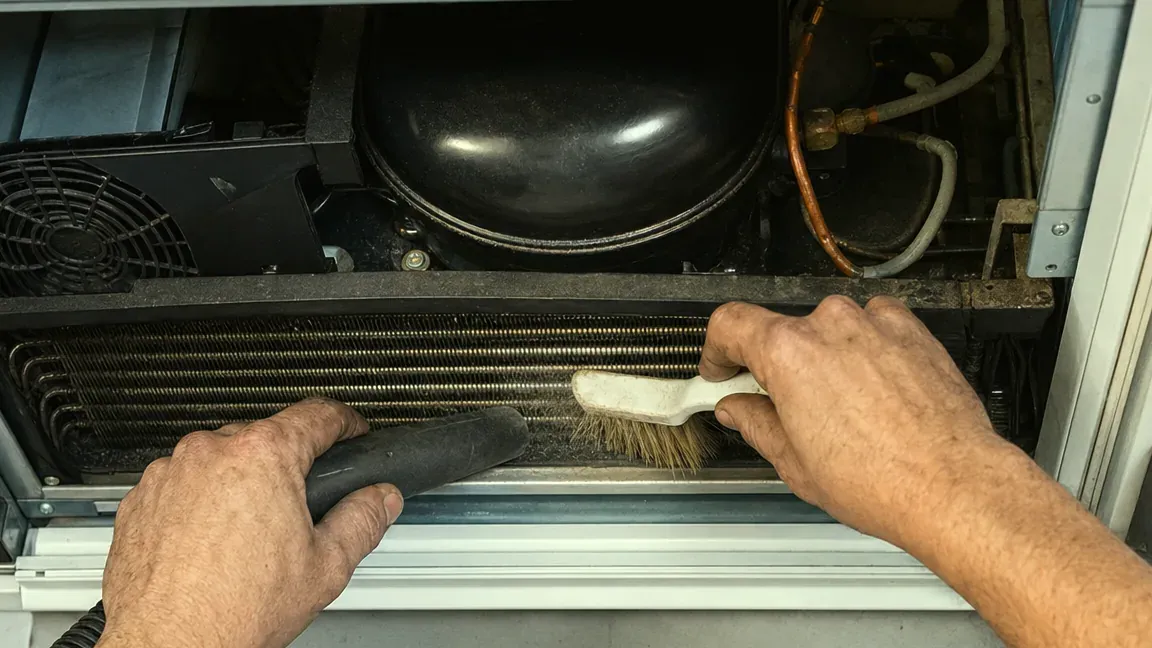
A dirty condenser also throttles ice, because the whole system runs warmer and longer. Sub-Zero says to clean it every six to twelve months, sooner with pets, using a soft brush and vacuum rather than chemical cleaners, and without bending the aluminum fins. On the UC-15I the condenser sits behind the kickplate and wants attention every six months. Along the High Line Canal corridor the cottonwoods shed heavy fluff each spring, and it packs into grilles quickly, so the cottonwood-season coil cleaning notes are worth a read before summer.
If you need a burst of ice for a gathering, Max ice on CL, DET and DEC models raises output by up to 30% for 24 hours. Some parts run faster while it is on and make a distinct sound, which is normal rather than a fault.
Water on the floor or cubes frozen into a block
Leaks around a Sub-Zero ice maker tend to come from three places. The supply fitting at the back can weep after the unit is moved for cleaning. A fill valve that does not close completely overfills the mold, so water spills into the bin and freezes the cubes into a solid clump. Undercounter machines melt and drain water as part of normal running, so a slow or blocked drain line shows up as a puddle under the toe kick.
Lay a towel down, dry everything and watch for where fresh water appears. If it is steady, close the shut-off valve and leave the ice maker off until someone looks at it. A clumped bin can be emptied and the ice discarded, but if it re-forms within a day the valve is the likely cause.
Cleaning and resetting
Mineral scale and slime build up slowly inside any ice maker, and both cut production. The UC-15I is due a clean and sanitize every six months. Start with CLEAN, empty out the bin, and when the light begins flashing pour in 4 ounces (115 ml) of cleaner. When that finishes, start a second cycle and use 1 tablespoon (15 ml) of sanitizer in place of the cleaner. Allow about 30 minutes per cycle, and never interrupt one, because a started clean cannot be canceled. The Designer Series Undercounter Ice Maker should be cleaned at startup and then every three to six months depending on water hardness, using 1/2 cup descaler and 1/2 tablespoon sanitizer; its default reminder is set at three months.
There is no single reset button on most models. The CFC fault clear is the true reset for a disabled valve, and switching the ice maker off and on from the panel clears minor hiccups. Cutting power at the breaker works too, but on a UC-15I it erases any Auto Delay schedule.
When to stop and what a repair usually costs
Stop troubleshooting and call if the flashing cube returns after a CFC clear, if good pressure reaches the unit but no water fills the mold, if the freezer itself feels warm, or if you hear repeated clicking from the back. Those point to a valve, sensor, fan or control fault rather than a setting.
A visit costs $89 including the diagnosis, and that $89 comes off the bill when you go ahead with the repair. As a typical range, an ice maker, water valve or supply line job runs $300–$750, a fan motor $320–$670, and an electronic control board $400–$1,020; the firm price follows the diagnosis. To keep it from happening again, a scheduled maintenance visit covers the condenser, drain and temperatures, and the month-by-month checklist shows when filters and coils come due. Call (720) 575-1433 to book.
Questions
What is the reset procedure for a Sub-Zero ice maker?
Most resets clear a fault rather than press a single button. If one ice cube icon is flashing without an alarm, make sure the water supply is open, then press and hold Alarm until CFC shows on the display. On a UC-15I, the REPLACE FILTER light goes out once you hold CLEAN for 6 seconds after fitting a new filter.
What stops a Sub-Zero from producing ice?
Usually the ice maker is off, stuck in Sabbath Mode or waiting out its bin delay, or water is not reaching the mold. Check that one ice cube icon is lit, slide the bin fully home, open the shut-off valve and replace an overdue filter. If ice still does not come within a day, the fill valve or controls need a proper diagnosis.
Where does water leaking from a Sub-Zero ice maker come from?
A leak almost always starts at the supply connection behind the unit, at a fill valve that no longer closes fully, or at a blocked drain on an undercounter ice machine. Dry the floor, look for drips along the line and close the shut-off if water keeps coming. A valve or line repair typically falls between $300–$750 once diagnosed.
What is the right way to clean a Sub-Zero ice maker?
For a UC-15I, press CLEAN and clear out the bin; once the light starts flashing, add 4 ounces (115 ml) of cleaner, and after that pass ends run another using 1 tablespoon (15 ml) of sanitizer, about 30 minutes apiece. A built-in refrigerator's ice maker only needs its bin emptied, washed in warm soapy water, dried and set back in place.
Should I throw away the ice after changing the water filter?
Yes, the first ice after a filter change should go down the sink. Sub-Zero advises dumping the first two full bins on Classic and Designer models without a dispenser, running water for two minutes on dispenser models, and discarding the first batch on a UC-15I, which purges trapped air and loose carbon.
Due for a coil cleaning?
Call Sub-Zero Repair Cherry Hills at (720) 575-1433, or pick a time online. Tell us whether the grille is at the top or the toe-kick.